Private Operational Systems vs Spreadsheets | ObsidianX
Learn why sensitive sales, stock, staff, balance, and support records are safer and easier to manage in a private operational system than in shared spreadsheets.
By ObsidianX
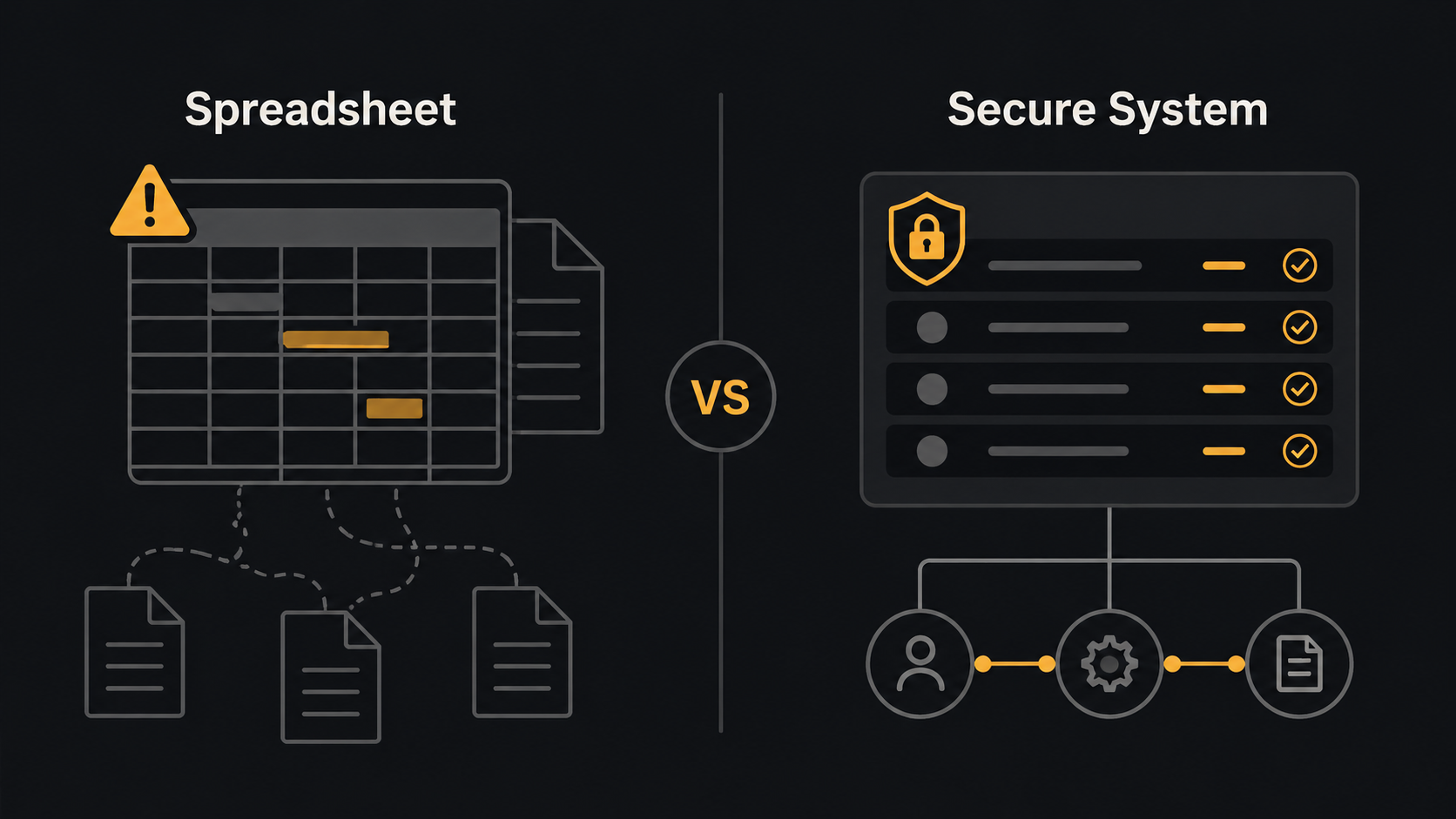
Spreadsheets are great until they become the business
Most businesses start with spreadsheets for a good reason. They are quick, familiar, and easy to change. If you need a list of stock, a simple sales tracker, or a rough balance sheet, a spreadsheet can get the job done.
The trouble starts when that same file becomes the place where everyone runs the business. Sales, balances, stock changes, customer notes, staff updates, and support issues all end up in one fragile workspace. At that point, the spreadsheet is no longer just a spreadsheet. It has become the operating system.
A shared file is not the same as controlled access
File permissions can decide who opens a document. They do not always decide what each person should be able to do once they are inside it.
One staff member may only need to submit an update. Another may need to review pending entries. A manager may need to see the wider account picture without exposing every sensitive note or internal record to everyone on the team.
That is where a private operational system becomes useful. It can give different people different surfaces for their work instead of asking everyone to be careful inside the same shared file.
Good visibility depends on clean structure
Business owners need to see what is happening without rebuilding the picture from scratch every day. In a spreadsheet, that often means filters, formulas, duplicated tabs, manual checks, and a lot of trust that nobody has accidentally broken something.
A dedicated system can keep the important records in a more predictable shape. Sales, stock, balances, staff actions, and support activity can be stored as real operational records, then shown through dashboards and lists that are easier to understand at a glance.
Staff updates should not get lost in messages
Many teams start by collecting updates through chats, screenshots, notes, or voice messages. That can work for a while, but it gets messy quickly. Important details are easy to miss, and it becomes hard to know what has been reviewed, approved, corrected, or added to the main record.
A better workflow gives staff a clear way to submit information and gives operators a clear way to review it. The update, the decision, and the record it affects should live close together.
Critical records need a calmer setup
When a spreadsheet holds sensitive business records, a lot depends on habits: who owns the file, who has a copy, who changed what, which version is current, and whether the formulas still mean what everyone thinks they mean.
Private systems do not remove every operational risk, but they can reduce the number of things that rely on memory and manual discipline. Access, roles, account management, and recovery planning can be handled more deliberately.
When it is time to move beyond spreadsheets
The right time to move is not about company size. It is about risk.
If a spreadsheet now controls live stock, customer-sensitive records, balances, staff submissions, support commitments, or account-level decisions, it may be carrying more responsibility than it was meant to handle.
Spreadsheets are still useful. The question is whether your most sensitive daily records should depend on a shared document, or on a private system built around controlled access and operational visibility.
Where ObsidianX fits
ObsidianX is built for businesses that need a private workspace for sensitive operational records. It focuses on secure access, clearer visibility, staff workflows, account management, and support activity.
For teams that have outgrown scattered files and informal updates, a private operational system can make daily work easier to follow, easier to control, and less dependent on one overloaded spreadsheet.